
Energy news - July 2026
A roundup of the latest energy news in July 2026, including Grid Reform Update, Energy Market Update, Small Scale Wind Permitted Development Rights changes, Rental Income Strip opportunity, as well as upcoming events.
Grid Reform Update
Grid Update – Spotlight on CMP470 impact on Battery Developers and Demand Connection Reform
Following the UK's grid connections reform process, Battery Energy Storage Systems (BESS) remain significantly oversubscribed. NESO has identified that over 90GW of BESS capacity is in Gate 2, against a 2035 target of just 29GW. With insufficient incentive for unviable projects to leave the queue, many of which currently carry zero cancellation charges, network planners cannot identify which projects will ultimately be built.
CMP470, raised in March 2026 and being progressed on an urgent basis, proposes to address this through an Oversubscribed Technologies Commitment Fee (OTCF). Where the total Gate 2 and operational capacity of a technology exceed 150% of its Clean Power 2030 target, a securities floor is applied to all projects in that technology type. The initial floor is set at £10,000/MW, meaning a 100MW project would need to arrange and hold £1 million in security, rising to £5 million for a 500MW project.
If oversubscription does not reduce quickly enough between twice yearly reviews, the floor escalates by £5,000/MW per period, up to a cap of £25,000/MW. Security is returned on successful connection and forfeited only on cancellation. For battery developers with projects that are not yet financially viable, this will bring an earlier and harder decision point.
Demand Connection Reform: What New Applicants Need to Know
Following the December 2025 connections reform, around 13GW of transmission connected demand can connect before 2030, with a further 86GW targeted for 2030-2035. However, with over 100GW of large-scale demand projects, predominantly data centres, still in the pipeline and many pushed toward 2035, Government and Ofgem launched parallel consultations in early 2026 on a further package of demand focused reforms.
These reforms apply to transmission connected demand projects, meaning those above 5MW in England and Wales and above 200kW in Scotland. For those in scope, the reforms introduce materially more demanding entry requirements than previously applied to demand connections. Readiness must now be demonstrated through one of two routes: the land route, requiring evidence of secured land rights in the form of an option agreement, lease, or ownership, supported by a defined red line boundary and minimum acreage based on the type and scale of the project; or the planning route, applicable to projects pursuing a Development Consent Order.
Securing land rights is therefore no longer simply a development milestone to be reached in due course. It is a prerequisite for joining the queue at all. Once in the queue, projects face ongoing milestone obligations, with land rights required to be confirmed within two months of offer acceptance and failure to comply triggering a 60-day remedy period before automatic termination. Developers should be securing option agreements now so that when the next Gate 2 window opens, expected in the second half of 2026, their project can demonstrate genuine readiness from day one.
Please contact the Carter Jonas Energy Team via Tom.Clements@carterjonas.co.uk if you would like to discuss how these changes may affect your project.
Energy Market Update
In a volatile and developing market, Carter Jonas’ Procurement Platform helps clients to find the best PPA price for their export generation as well as options for sleeved PPAs and gas and electric supply contracts. See below for this week's latest on the UK & EU gas, UK power & renewables and the oil & carbon markets, in partnership with PPAYA.
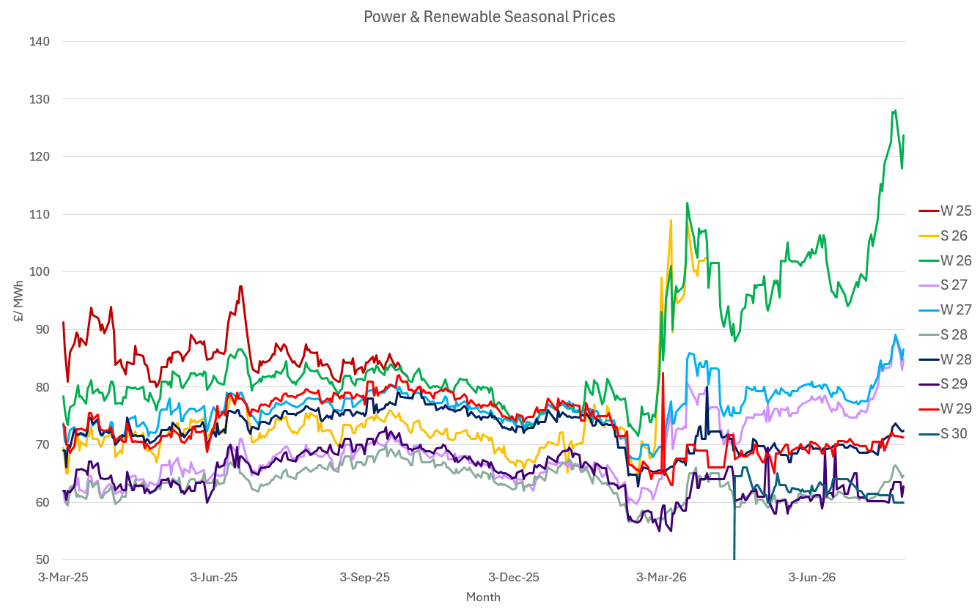
Power & Renewable Seasonal Prices - July 2026
Weather
The record-breaking heat throughout June and July is expected to continue throughout the summer, though there is an area of low pressure moving in, expected to cause storms in early-mid August. In the latter half of August, we expect a further hot and dry spell.
Gas
European gas markets continue to focus on storage replenishment ahead of winter, with traders closely monitoring gas availability and Norwegian export flows. While prompt market conditions remain relatively comfortable due to low seasonal demand, there are concerns around the pace of storage injections and Europe's ongoing reliance on global gas supplies.
Norwegian gas remains a key supply source for the UK and continental Europe, with maintenance schedules continuing to influence market sentiment. At the same time, strong renewable generation and warmer temperatures are helping to keep near-term gas consumption subdued.
Geopolitical developments in the Middle East remain a major source of uncertainty. Markets have been encouraged by renewed diplomatic efforts between the US and Iran, which have helped ease concerns over the security of gas and energy shipments through the Strait of Hormuz. However, traders remain cautious given the fragility of the situation and the potential for further disruption.
Power & Renewables
UK power prices are mixed recently, with renewable generation continuing to weigh on prompt contracts. Strong solar output and improving wind generation are helping to maintain comfortable system margins.
National electricity demand is currently around 32 GW, with renewables contributing approximately 60% of generation. Solar is the largest contributor within the renewable mix, while wind generation is providing around 6 GW of output. Imports from neighbouring markets continue to play a supporting role in balancing the system.
Andy Burnham’s entry into Downing Street has renewed attentions to energy, with his recent announcement to consider reforming the gas standing charge, alongside targeted tariff cuts, causing immediate market reactions.
Oil & Carbon
Brent crude has remained under pressure in recent weeks as concerns over a potential global supply surplus have mounted. However, oil markets remain highly sensitive to developments affecting key export routes, particularly the Strait of Hormuz. Any disruption to shipping activity through the Strait could reintroduce volatility and provide significant upside risk to both oil prices and wider energy markets.
Small Scale Wind Permitted Development Rights Update
The wind planning system
At present, the planning system in England creates a significant hurdle for anyone wanting to install a wind turbine to provide electricity to a farm or business. While some limited permitted development rights already exist for the installation of a single turbine at domestic properties, they do not generally apply to farms, commercial premises or other business sites. As a result, even relatively modest wind turbine projects normally require a full planning application, costing up to £30,000 on top of installation costs.
In March 2026, the Department for Energy Security and Net Zero launched a consultation on new permitted development rights for onshore wind turbines in England. The consultation closed on 10 June, and the government is now considering its response. We are anticipating the response will be published in Autumn but the changes within the government could push it out to wintertime.
The proposed PDRs
The key proposal is the introduction of a new permitted development right for small-scale wind turbines in non-domestic settings. The proposal would allow a single turbine with a maximum tip height of 30 metres, and a rotor swept area of up to 200 square metres. In practical terms, that could accommodate a turbine of around 50kW capacity. It is estimated that a 50kW turbine operating at a 20% load factor could generate around 88,000kWh of electricity per year, enough to meet the annual electricity demand of many medium-sized farming operations.
While we are enthusiastic about the proposals, it is important to avoid presenting them as a solution for every landowner. Successful wind projects depend on wind resource, site characteristics, energy demand patterns and grid availability. Also, these proposals are intended to simplify the planning process, not remove controls altogether. A qualifying turbine may no longer require a full planning application, but restrictions would still apply relating to matters such as neighbouring properties, protected landscapes, heritage assets, environmental impacts and aviation interests.
The economics of small-scale wind projects are generally strongest when the majority of the electricity generated is used directly on the farm. Current electricity purchase costs may be around 25p per kilowatt hour, while export prices may only be 10 to 15p per kilowatt hour. Therefore, every unit of electricity used on-site is currently worth significantly more than electricity exported to the grid.
For those considering whether small-scale wind might be suitable for their site, Carter Jonas can help assess the technical and financial viability of a project and guide clients through the development process. Please contact Tom Clements for more information.
Tom Clements
Senior Energy Specialist

Rental Income Strip Opportunity – Unlocking capital from Renewable Energy Leases
For landowners who signed a renewable energy lease over the last decade, it may be time to revisit the conversation around the long-term value of the income stream. What started out as a niche diversification play is now attracting serious institutional capital, and that changes the equation on whether to continue receiving rent over time or realise some of that value today.
Investors are paying attention
Over the past year we've seen large real estate and infrastructure investors, including pension-backed funds, begin targeting UK renewable energy ground leases. They are attracted by the same characteristics that have drawn institutional capital to sectors like student accommodation and social housing for many years: long- term, inflation-linked, secured income streams.
As a result, renewable energy leases are increasingly being recognised as an investment class in their own right which is creating a deeper and more competitive market for this type of income.
Why review this now
There are two reasons why landowners may wish to revisit their position.
First, growing investor demand has increased the options available to those holding renewable energy leases. Income streams that might previously have been viewed simply as a source of annual rental income are now attracting interest from investors seeking long-term returns.
Second, changes to inheritance tax relief from April 2026 are prompting many landowners to review wider estate and succession planning arrangements. Land subject to a renewable lease will often require separate consideration, making it sensible to assess how these assets and income streams fit within broader family and business objectives.
What this means in practice
A rental income strip allows a landowner to convert some or all of the remaining rent under a lease into an upfront lump sum, while retaining ownership of the underlying land.
For some, this may provide greater flexibility around succession planning, debt reduction, reinvestment or wider family wealth planning. It is not a replacement for those discussions, but potentially another tool to consider alongside them.
The tax treatment of any transaction will depend on individual circumstances and the structure adopted, so landowners should seek advice from their own tax adviser before proceeding.
If you would like independent advice on the options available under an existing renewable energy lease and whether a rental income strip may be appropriate, technologies, please get in touch with Will Hunt. This applies predominantly to solar, wind and BESS leases, though there is potential for wider technologies.
William Hunt
Energy Specialist

Upcoming Events
Several members of the team will be attending Solar and Storage Live on 22-24 September and will have a stand at station E90.
Please get in touch with Tom Clements on Tom.Clements@carterjonas.co.uk if you would like to meet up with anyone in the team.
Tailored newsletters for you
Sign up to our newsletter to receive further information and news tailored to you.