

MEES Reset: The deadline has moved, but the problem hasn’t
Key finding: 63% of larger commercial spaces are still below EPC B.
Carter Jonas’ analysis of EPC records shows that almost two-thirds of office, industrial and retail spaces above 1,000 sq m are rated EPC C-G. The government may have reduced the regulatory universe, but the scale of the upgrade challenge remains substantial.
The Government's June 2026 interim response has reset the proposed Minimum Energy Efficiency Standards (MEES) timetable for commercial property. Rather than an EPC C milestone in 2027 followed by EPC B in 2030 across the wider non-domestic private rented sector, the new approach proposes EPC B from 2031 for privately rented buildings over 1,000 sq m in England and Wales, where this is cost-effective. Buildings below the threshold would remain subject to the existing EPC E minimum. Secondary legislation is still required before the change takes effect.
That change offers landlords more time and narrows the group facing the higher statutory standard. However, our analysis of non-domestic EPC records suggests that the remaining challenge is still substantial - and differs considerably between sectors.
Larger premises are better placed - but far from ready
Across the office, industrial and retail categories analysed, assessed spaces above 1,000 sq m account for a relatively small share of EPC records, although they are likely to represent a much larger share of commercial floorspace and energy use. The proportion varies sharply by sector: 27% for industrial, 12% for offices and just 6% for retail.
Larger assessed spaces tend to have stronger EPC profiles than their respective sectors as a whole. Among office records covering more than 1,000 sq m, 33% are already rated B or better, compared with 21% of all office records. The equivalent figures are 31% versus 23% for industrial and 50% versus 24% for retail. In that sense, the targeted approach focuses on a cohort that is generally better positioned to improve.
Nevertheless, most EPC records covering large spaces remain below the proposed standard. Around 67% of office records above 1,000 sq m and 69% of equivalent industrial records are rated C-G. Retail is further ahead, although half of the records still sit below EPC B.
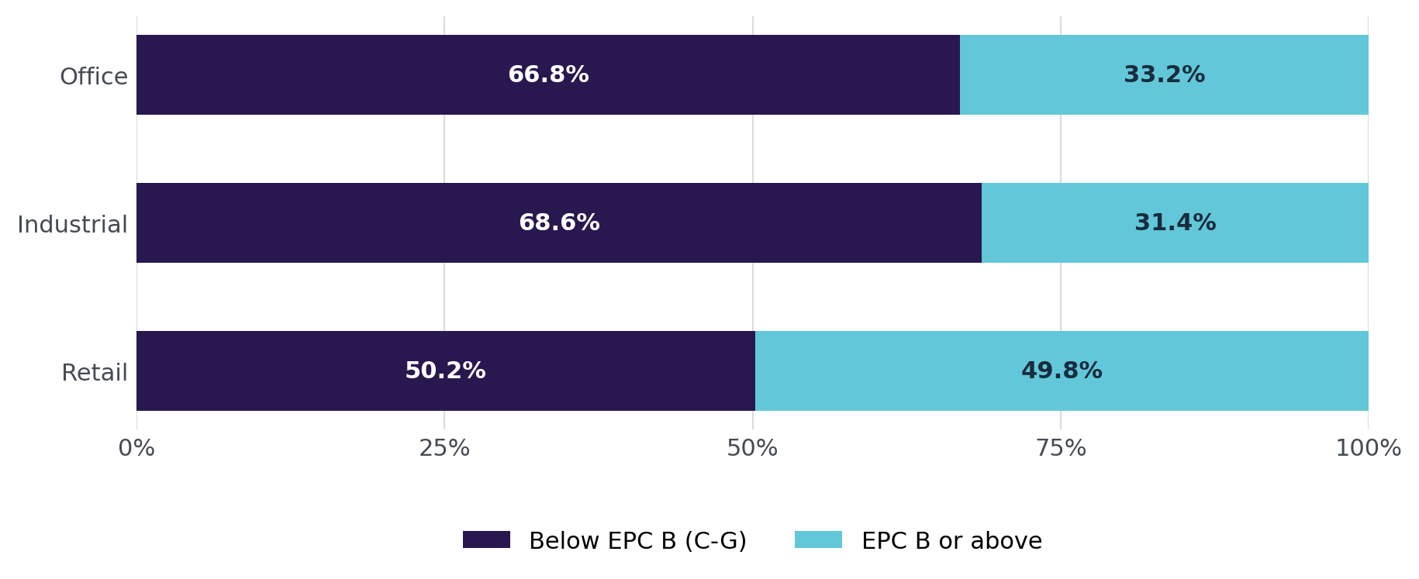
Figure 1: EPC position of assessed spaces above 1,000 sq m
Source: Carter Jonas analysis of England and Wales non-domestic EPC records issued within the previous ten years. Percentages may not sum due to rounding.
Band C is the critical cohort
The most immediate opportunity for improving EPC performance lies within Band C, which accounts for around one-third of assessed spaces above 1,000 sq m. This includes 30% of office, 36% of industrial and 32% of retail records. As these spaces are already relatively close to the proposed EPC B threshold, targeted refurbishment and energy-efficiency measures could provide a more achievable route to meeting the proposed standard than for lower-rated stock. However, moving from C to B will not necessarily be simple or low-cost. The scale and viability of the required works will depend on building services, fabric, lease structures, refurbishment cycles and the continued application of the seven-year payback test and other exemptions.
Retrofit demand could be concentrated
The removal of the 2027 milestone, therefore, reduces the immediate cliff edge, but it may also encourage some owners to defer decisions. That carries risk. If a large share of projects is pushed towards the end of the decade, competition for specialist contractors and equipment could intensify, while works may be harder to align with lease events and planned capital programmes.
Regulatory relief does not remove market pressure
Better-performing buildings could gain a competitive advantage.
The policy threshold is only one measure of exposure. Smaller buildings may remain outside the proposed EPC B requirement, but occupier expectations, operational costs, lending criteria and investor scrutiny are unlikely to stop at 1,000 sq m. A two-tier market could therefore become more pronounced: assets with clear improvement pathways should be better placed to protect liquidity and income, while poorly performing secondary stock may face rising capital expenditure requirements and a narrower pool of occupiers and buyers.
The revised timetable should be treated as a planning window rather than a reason to pause. Portfolio audits, asset-level improvement pathways and early integration of energy works into lease and refurbishment strategies will be essential. The regulated universe may now be smaller, but the scale of the upgrade challenge remains significant.
The MEES reset has moved the deadline, reduced the number of buildings directly in scope and removed the immediate 2027 cliff edge. But it has not removed the need to understand which assets can realistically reach EPC B, what that will cost and when the work needs to happen.
For owners/landlords, 2031 should therefore be viewed less as a deadline and more as a planning horizon. For tenants, it allows time for a wider conversation with landlords on undertaking a programme of upgrades to reach the standard.
Rad Radev
Associate Research Analyst

Tailored newsletters for you
Sign up to our newsletter to receive further information and news tailored to you.