

Reflections on Planning and Development Priorities for Andy Burnham and Angela Rayner
The new leadership has renewed the housing promise. The next task is to make the delivery system work.
Katy Davis, National Head of Planning, Carter Jonas
Andy Burnham’s arrival in Downing Street and Angela Rayner’s return to the MHCLG create a fresh opportunity to address the manifesto commitments on planning and development, most notably, the increasingly elusive target of 1.5 million new homes.
Following extensive planning reforms, much of the policy architecture is now in place. Andy Burnham’s appointment as Prime Minister has shifted the political emphasis slightly, with a promise to build more council homes and a renewed focus on devolution, public land and delivery from outside Whitehall.
For this article, we revisit two Carter Jonas practitioner surveys carried out earlier this year, one of planning professionals and the other of development professionals, and consider the priorities for the new Prime Minister and Housing Secretary: where should they focus their efforts to ensure that policy results in a reliable flow of permissions, land transactions, starts and completed homes?
The pipeline is responding, but unevenly
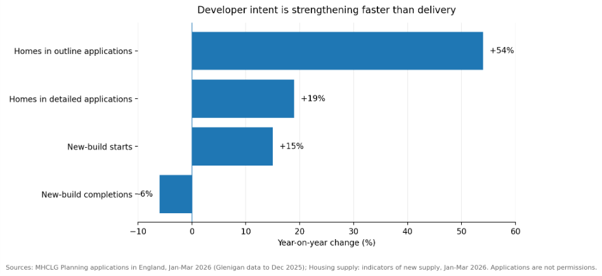
The clearest sign of change is in the early stages of the housing pipeline. MHCLG’s recently published data shows that 206,000 homes were included in outline applications in the year to December 2025, 54% more than a year earlier. Detailed applications were submitted for 303,000 homes, up 19%.
But these figures show strengthening developer intent rather than faster planning consent: the same dataset (section 3.12) notes that MHCLG has temporarily removed its latest estimates of residential units granted permission while it undertakes further quality assurance. For now, applications, not permissions, provide the clearest current indication that more housing is entering the front of the system.
Further down the pipeline, the improvement is less convincing. In the year to March 2026, new-build starts rose 15% to 130,170, while completions fell 6% to 143,110. The latest quarterly figures offer only tentative improvement: starts were 18% higher and completions 3% higher than a year earlier.
Developer intent
The same gap is visible in the land market. In Carter Jonas’ development survey, 75% of respondents reported fewer residential land launches; a similar number said achieved residential land values had fallen, and a majority described their regional market as weaker, with the remaining respondent calling it polarised.
Taken together, the evidence suggests that planning reform is encouraging more activity at the beginning of the pipeline, but the commercial conditions needed to turn that activity into land transactions, starts on site and completed homes are not improving at the same rate. The challenge for the new leadership therefore is not simply to create more planning opportunities, but to improve the circumstances for deliverability.
Use No. 10 North to join up planning and delivery
Andy Burnham has created No. 10 North as ‘the engine room of devolution and good growth in every postcode,’,’ with strategic functions moved from MHCLG to the Prime Minister’s own office. That creates an opportunity to connect decisions that are too often handled in sequence and by different departments: specifically, housing numbers, transport investment, electricity and water capacity, schools, health facilities and land assembly, alongside the commercial conditions needed for land to transact and development to begin.
This addresses another issue highlighted in the planning survey: utilities featured among the three most significant constraints for 20% of respondents, rising to 28% among those least confident about the housing target. The development survey identified the same problem later in the process: utilities capacity and programme were cited as a source of delay during due diligence, and as a factor in late-stage price renegotiation, alongside abnormal costs and affordable housing assumptions.
The survey findings point to a practical response: strategic sites need a named delivery lead and an agreed route for escalating infrastructure blockages across departments, regulators and providers. No. 10 North could convene that process with mayors and local authorities, while MHCLG retains clear ownership of planning policy and local delivery. Its success will depend on defined responsibilities rather than another layer of coordination meetings.
Council housing should widen the delivery coalition
Andy Burnham’s commitment to a major council housebuilding programme gives public-sector delivery greater prominence alongside private development. The existing £39 billion Social and Affordable Homes Programme provides a substantial foundation. Public land, long-term grant and stronger council capability can further strengthen the housing system, but scaling up will depend on a broad coalition of councils, housing associations, private housebuilders, SMEs, investors and landowners. That same coalition must also work at scheme level. One respondent to our development survey described a land deal that had to be restructured because a Registered Provider partner could not be secured. A larger public programme could reduce some of that friction, but only if grant, land, Registered Provider capacity and delivery timetables are aligned early enough for the affordable housing element to remain financeable.
Planning reform and viability must move together
It is notable that in our planning survey, viability pressure appeared among the top three delivery constraints. The development survey shows how that pressure is being absorbed in the land market: 75% identified affordable housing expectations and viability as a constraint, and 75% said achieved residential land values had decreased, while 62.5% said landowner price expectations had stayed broadly flat. Almost all reported greater conditionality in deal structures, structures and over half had experienced more deferred consideration.
Deal structures are being used to bridge the gap between policy opportunity and a transaction that can be funded, but they do not resolve it. The outlook may improve: Glenigan forecasts a 13% rise in private housing starts in 2027, supported by lower borrowing costs, rising real incomes and improving confidence. But in the meantime, government should protect the conditions for that recovery while public investment broadens the range of homes being built.
Support SMEs while protecting affordable housing
The proposed treatment of medium-sized sites illustrates the balance required. The government is considering planning easements for developments of 10 to 49 homes. The National Housing Federation estimates that removing on-site affordable housing requirements at this scale could put 32,000 rural affordable homes at risk over a decade. A nationally simple threshold may have very different effects in a city and a village.
The development survey reinforces the need for care: SMEs were the group most often identified as risk-averse and smaller schemes have less capacity to absorb changes in build costs, finance, technical standards or affordable housing assumptions. In taking forward the medium-site reforms, MHCLG should allow for rural evidence, make payments in lieu genuinely deliverable, and align Section 106, grant funding and registered provider demand so affordable homes are neither promised without a buyer nor removed without a replacement.
Stability amid change
Policy clarity was one of the few areas in which the planning consultants reported improvement. Development respondents were more divided: half said planning policy clarity had improved deal certainty, while the other half said nothing had improved materially. Over half said viability expectations and negotiation had worsened certainty.
The new leadership has inherited an extensive programme of NPPF reform, a new towns programme, local government reorganisation and a move towards strategic planning - all as the Planning and Infrastructure Act introduces further change. Confidence requires outstanding decisions to be made, new policies to settle and the new system to be proven successful. For the land market, stability also means allowing buyers and landowners to appraise sites against assumptions that are unlikely to change before a transaction completes.
A first-year planning and development scorecard
The first year of the Burnham-Rayner partnership should be judged on both planning and development outcomes. On planning, the useful measures are a larger share of major applications determined within the statutory period, shorter and more transparent Section 106 negotiations, faster statutory consultee responses and clear infrastructure delivery plans for strategic sites. On development, the signals are more residential land launches and completed purchases, a narrowing gap between landowner expectations and achieved values, fewer late-stage re-trades associated with infrastructure or affordable housing assumptions and, ultimately, growth in both market and social housing completions. It’s a long list, but progress on these measures would certainly provide a strong indication of future delivery.
Andy Burnham has made housing central to his vision of a more active and devolved state. Angela Rayner returns to a department whose policy direction she helped establish. Their opportunity is to turn renewed political energy into institutional capacity and commercial confidence - giving planners, councils, infrastructure providers, landowners, investors and developers enough certainty to move land from opportunity to transaction, applications to permission and permissions to completed homes.
Katy Davis
Partner, Head of Planning
BA (Hons), MSc MRICS

Tailored newsletters for you
Sign up to our newsletter to receive further information and news tailored to you.